
Can a Chiropractor Help With TMJ?

If you’re dealing with persistent jaw pain, clicking sounds when you chew, or tension headaches that won’t quit, you’ve probably wondered: is chiropractor good for you when it comes to TMJ issues? At North Alabama Spine & Rehab, we’re here to tell you there’s hope beyond pain medications and invasive procedures.
What Is TMJ (Temporomandibular Joint) Disorder?
Let’s start by clearing up some common confusion. TMJ refers to the temporomandibular joint itself – the hinge connecting your jawbone to your skull. TMD (temporomandibular disorder) is the actual dysfunction or pain in that joint. Most people use “TMJ” to describe both, and that’s fine – we know what you mean.
Your jaw joint is remarkably complex. It’s one of the most frequently used joints in your body, moving thousands of times daily as you talk, chew, yawn, and even breathe. When something goes wrong with this intricate system, the effects ripple throughout your head, neck, and shoulders.
Common symptoms include:
- Jaw pain
- Popping or clicking sounds
- Frequent headaches
- Ear pain that isn’t from an ear infection
- Neck tension
- Facial tightness
How TMJ Problems Develop
We’ve treated hundreds of TMJ cases, and certain patterns emerge. Stress is a massive contributor – when you’re anxious, you clench your jaw without realizing it. Teeth grinding (bruxism), especially during sleep, wears down the joint over time. Whiplash from car accidents can throw everything out of alignment.
But here’s the game-changer: forward head posture and spinal misalignment play a huge role in jaw tension.
Lifestyle factors make everything worse. Hours staring at screens, sleeping on your stomach, and chronic stress all feed into the TMJ cycle.
How We Assess TMJ Dysfunction at Our Clinic
When you come in for a TMJ chiropractor evaluation, we don’t just look at your jaw. We examine the whole picture. During your initial visit, we assess jaw movement patterns, check your neck alignment, and analyze your overall posture. We’re looking for restrictions, asymmetries, and compensations your body has made.
Sometimes we use imaging or motion tests to guide our diagnosis. X-rays can reveal cervical spine misalignments that contribute to jaw dysfunction. We also determine whether Chiropractic BioPhysics (CBP) – our specialized approach to structural correction – is suitable for your case.
This comprehensive evaluation is what sets chiropractic for TMJ apart from simply treating the symptoms. We’re hunting for the root cause.
How Chiropractic Care Can Help With TMJ Pain
1. Restoring Proper Alignment Through Chiropractic BioPhysics
TMJ treatment focuses on correcting cervical spine alignment to relieve pressure on your jaw. Why? Because neck posture directly affects jaw mechanics. When your cervical spine is misaligned, your jaw must work harder to maintain proper function.
Research by Dr. Donald Harrison, founder of CBP, demonstrates that correcting spinal alignment produces measurable, long-term improvements in related conditions. This isn’t just anecdotal – it’s backed by science.
2. Releasing Soft Tissue and Muscular Tension
Chiropractor jaw pain treatment involves more than adjustments. We use myofascial release, trigger point therapy, and gentle muscle work around your jaw, neck, and shoulders. These techniques reduce inflammation and improve joint motion.
The muscles around your TMJ – the masseter, temporalis, and pterygoids – often hold tremendous tension. When we release these muscles, patients frequently experience immediate relief. It’s like finally loosening a knot that’s been tightening for months or years.
3. Improving Jaw Function Through Joint Mobilization and Corrective Exercises
Gentle joint mobilization helps improve TMJ range of motion without forcing anything. We guide your jaw through proper movement patterns, retraining the joint to function correctly. This is a key component of chiropractic TMJ treatment.
We also provide at-home exercises to strengthen and relax jaw muscles. These might include gentle stretches, resistance exercises, and relaxation techniques. Consistency with these exercises accelerates your progress significantly.
4. Correcting Posture and Daily Habits
Long-term relief requires addressing the habits that created the problem. We provide guidance on ergonomics, sleep positions, and even breathing patterns that affect jaw tension. Small changes – like adjusting your computer monitor height or switching your sleeping position – can make a dramatic difference.
Treatment Timeline and Investment
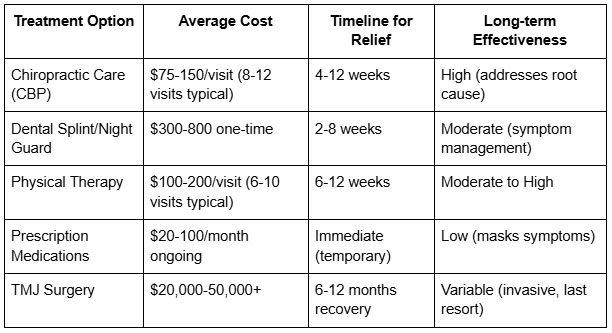
Most patients see noticeable improvement within 4-6 weeks of chiropractic TMJ treatment, with continued progress over 2-3 months. The investment in conservative care is significantly lower than surgical options and carries minimal risk.
Are There Any Risks or Side Effects?
We use gentle, safe techniques specifically designed for TMJ cases. Unlike high-velocity adjustments used elsewhere, our CBP approach is measured and controlled. Some patients experience temporary soreness – similar to post-workout muscle fatigue – but this typically resolves within 24-48 hours.
If symptoms persist despite appropriate care, we refer to other specialists. Good chiropractors know their scope and aren’t afraid to involve others when needed. Your wellbeing comes first.
Your Path to Natural TMJ Relief
Is a chiropractor good for you if you’re dealing with TMJ? Based on over a decade treating patients at our clinic, we believe chiropractic care – especially Chiropractic BioPhysics – offers one of the most effective, non-invasive approaches to TMJ dysfunction.
We don’t just mask symptoms with medication. We target spinal and jaw alignment, release muscle tension, and correct the postural issues driving your pain. This comprehensive approach delivers natural TMJ relief that actually lasts.
Long-term results come from correcting the root cause, not just treating symptoms. That’s the difference between feeling better temporarily and actually getting better.
Ready to find relief? If you’re struggling with TMJ discomfort, schedule a consultation with North Alabama Spine & Rehab today. Let’s discover how Chiropractic BioPhysics can help restore your comfort, alignment, and quality of life. You don’t have to live with jaw pain – we can help.
FAQs
Can neck misalignment cause TMJ?
Absolutely. Studies show that neck misalignment causes TMJ dysfunction through altered biomechanics and muscle compensation patterns. The cervical spine and jaw function as an integrated unit.
How long does it take to see results from chiropractic treatment?
Most patients notice improvements within 2-4 weeks, with significant relief by 8-12 weeks. Chronic cases may require longer.
Is chiropractic safe for jaw pain?
Yes. Chiropractic care for TMJ is non-invasive and carries minimal risk when performed by trained professionals.