
How Long Does Whiplash Take to Heal?

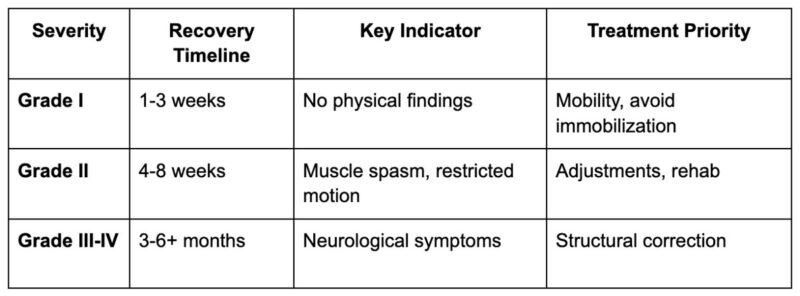
How long whiplash takes to heal depends on injury severity – mild cases recover in 1-3 weeks, moderate whiplash requires 4-8 weeks, while severe injuries with neurological involvement may take 3-6+ months, especially when proper structural correction isn’t addressed early.
The answer isn’t simple because whiplash isn’t simple. But understanding the healing timeline and what influences recovery helps you make informed decisions about treatment and set realistic expectations.
What Is Whiplash and Why It Happens
Whiplash is an acceleration-deceleration injury where your head violently whips forward and backward (or side-to-side), straining the soft tissues and structures of your cervical spine beyond their normal range of motion.
Common Causes
Car accidents (especially rear-end collisions) are the most frequent culprits, but whiplash also results from:
- Contact sports injuries (football, hockey, rugby)
- Physical assaults
- Amusement park rides
- Falls where head snaps backward or forward
Why Whiplash Affects Multiple Structures
The violent motion damages:
- Muscles: Overstretched, creating micro-tears and protective spasm
- Ligaments: Stretched or torn, destabilizing joints
- Intervertebral discs: Compressed or torn from shearing forces
- Facet joints: Jammed together or stretched apart abnormally
- Nerves: Irritated from inflammation, compression, or direct trauma
Why It’s More Than “Just a Sore Neck”
Whiplash isn’t a bruise that fades in a few days. The forces involved can:
- Reverse your normal cervical curve
- Create spinal instability
- Trigger chronic inflammation
- Sensitize your nervous system
- Alter movement patterns permanently if uncorrected
This is why whiplash victims often develop chronic pain when injuries aren’t properly treated.
How Do You Know If You Have Whiplash?
Many people don’t realize they have whiplash initially because adrenaline masks pain and symptoms often delay.
Common Symptoms of Whiplash
Immediate to within 24 hours:
- Neck pain and stiffness
- Reduced range of motion (can’t turn head normally)
- Headaches, especially at the skull base
- Shoulder and upper back pain
- Muscle tenderness and tightness
Additional symptoms that may develop:
- Dizziness or vertigo
- Fatigue and difficulty concentrating
- Blurred vision
- Ringing in ears (tinnitus)
- Sleep disturbances
- Irritability and mood changes
Delayed Symptoms
Don’t be fooled if you feel “fine” at the accident scene. Whiplash symptoms commonly appear 12-72 hours after injury due to:
- Inflammatory response timeline: Tissue damage triggers inflammation that builds over 24-72 hours, gradually increasing pain and stiffness.
- Nervous system sensitization: Initial shock and adrenaline wear off, allowing pain signals to register fully.
- Muscle guarding: Protective muscle spasm develops as your body tries to stabilize injured areas.
- Why early imaging appears normal: X-rays and even MRIs taken immediately after injury may not show soft tissue damage that becomes evident days later.
See more: Understanding Whiplash Post-Accident: A Guide to Recognizing and Addressing the Symptoms
How Long Does Whiplash Take to Heal?
How long does whiplash take to heal? The timeline varies dramatically based on injury severity, classified by the Quebec Task Force grading system.
What Factors Affect How Long Whiplash Takes to Heal?
Recovery isn’t just about injury severity – multiple factors influence healing timelines.
- Severity and direction of impact: High-speed collisions and side-impacts typically cause more damage than low-speed rear-ends.
- Age and pre-existing conditions: Older patients and those with prior cervical degeneration or arthritis heal slower.
- Delayed or passive treatment: Waiting weeks before seeking care or using only passive treatments (heat, massage, medication) prolongs recovery.
- Loss of normal cervical curve: Whiplash commonly reverses or flattens the natural C-curve of your neck. Uncorrected curve loss leads to chronic problems.
- Stress, sleep quality, and nervous system load: Chronic stress and poor sleep impair tissue healing and sensitize pain pathways.
- Posture and daily movement habits: Returning to poor desk posture or “tech neck” positions slows healing and increases re-injury risk.
Treatment Options That Support Faster, Safer Healing
How long does whiplash take to heal largely depends on the quality and timing of treatment you receive.
Early Care (First 72 Hours)
Relative rest vs immobilization: Keep moving gently. Soft neck collars beyond 48 hours actually delay recovery by promoting muscle weakness and stiffness.
Ice therapy: 15-20 minutes every 2-3 hours reduces initial inflammation.
Gentle movement: Slow, pain-free neck rotations and tilts maintain mobility without aggravating injury.
Inflammation control: Short-term anti-inflammatories may help (consult your doctor), but don’t rely on medication alone.
Chiropractic BioPhysics® & Postural Rehabilitation
As a chiropractor Huntsville whiplash patients trust, I’ve seen how CBP® protocols dramatically improve outcomes and reduce chronic pain risk.
Why CBP® matters for whiplash:
- Restoring cervical curve: Whiplash often reverses or flattens your neck curve. CBP® uses specific traction and mirror-image® adjustments systematically restoring proper curvature.
- Improving biomechanics: Corrected alignment distributes forces evenly, reducing strain on healing tissues.
- Stabilizing injured structures: Proper structure supports ligaments and discs as they heal, preventing chronic instability.
- Preventing long-term degeneration: Uncorrected whiplash accelerates arthritis and disc degeneration. Structural correction prevents this cascade.
Physical Therapy & Corrective Exercise
Rehabilitation components include:
- Deep neck stabilizer strengthening: Targeting muscles that support proper cervical positioning
- Mobility exercises: Maintaining and gradually improving range of motion
- Neuromuscular retraining: Re-educating movement patterns disrupted by injury
- Postural exercises: Preventing compensatory patterns that perpetuate problems
Pain Management
Short-term medication may help manage acute symptoms, but shouldn’t be the only approach.
Avoid:
- Long-term opioid use (addiction risk)
- Relying solely on muscle relaxants (they don’t heal tissues)
- Cortisone injections without addressing structural causes
Focus instead on treatments promoting actual healing, not just symptom masking.
Key Takeaway
How long does whiplash take to heal? It depends on injury severity, how quickly you seek care, and whether treatment addresses structural problems or just chases symptoms.
Early, corrective treatment dramatically improves outcomes. Patients starting CBP®-based care within the first 2-4 weeks typically recover faster and have lower chronic pain rates than those who wait or receive only passive treatments.
Structural healing matters more than symptom relief alone. Feeling better doesn’t mean you’re healed if cervical curve loss and biomechanical dysfunction remain uncorrected.
Don’t guess about your whiplash recovery timeline or hope it “just goes away.” At North Alabama Spine & Rehab, we provide comprehensive evaluations identifying exactly how severe your whiplash is and what treatment will support optimal healing.
If you’ve been injured in an accident – even if you feel “okay” right now – schedule your whiplash assessment today. We’ll perform thorough examination, take necessary X-rays, explain exactly what’s damaged, and create a treatment plan addressing structural problems, not just symptoms.