
Pinched Nerve vs Herniated Disc: Symptoms, Key Differences, and When to Get Checked
Pain shooting down your leg. Tingling in your fingers. A burning sensation in your neck or back that won’t quit. These symptoms send people searching and the search almost always leads to the same question: is this a pinched nerve vs herniated disc?
Here’s what most people don’t realize: these two conditions are closely related but not the same thing. Confusing them leads to confusion about treatment. This guide sorts out the differences clearly so you know what you’re dealing with and what to do about it.
*This article is educational and does not replace a clinical evaluation.
What Is a Pinched Nerve?
What “Pinched Nerve” Really Means
A pinched nerve isn’t a diagnosis – it’s a description. It means a nerve is being compressed, irritated, or inflamed somewhere along its pathway. The nerve is being squeezed, and it’s reacting by firing abnormal signals: pain, tingling, numbness, or weakness.
Common Causes of a Pinched Nerve
Many structures can compress a nerve:
- Herniated or bulging disc pressing on a nerve root
- Bone spurs from joint degeneration
- Inflammation or swelling in surrounding tissue
- Poor posture or repetitive stress narrowing nerve spaces over time
Where Pinched Nerves Commonly Occur
The cervical spine (neck) and lumbar spine (lower back) are the most common locations – because these areas have the most mobility and the most nerve root exposure.
What Is a Herniated Disc?
How a Disc Becomes Herniated
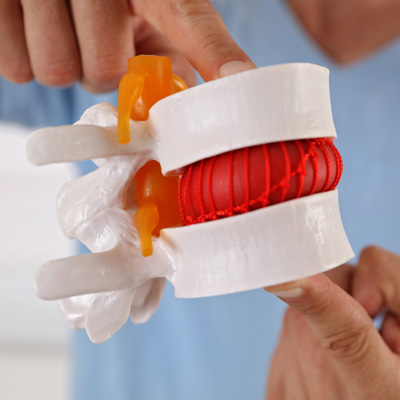
The discs between your vertebrae have a tough outer layer and a softer inner core. When the outer layer weakens or tears – from injury, age, or sustained pressure – the inner material pushes outward. That’s a herniated disc.
Why Herniated Discs Can Affect Nearby Nerves
When disc material bulges outward, it can press directly on an adjacent nerve root – or the inflammation it creates can irritate nearby nerves even without direct contact. This is why a herniated disc is one of the leading causes of a pinched nerve.
Common Locations
- Cervical spine – causing arm, shoulder, or hand symptoms
- Lumbar spine – causing hip, leg, or foot symptoms (classic sciatica pattern)
Pinched Nerve vs Herniated Disc: What Is the Main Difference?
Think of it this way:
- A pinched nerve is the effect – what’s happening to the nerve
- A herniated disc is a structural cause – one of several things that can create that effect
Why the Two Are Often Confused
Their symptoms overlap significantly. Both can cause pain, tingling, numbness, and weakness. And crucially – both conditions can exist at the same time in the same patient. This is exactly why symptoms alone rarely tell the full story.
Pinched Nerve vs Herniated Disc: Symptom Comparison
Symptoms More Commonly Associated With a Pinched Nerve
- Sharp, electric, or burning pain
- Tingling (“pins and needles”) along a nerve pathway
- Numbness in a specific region
- Muscle weakness in the area the nerve controls
Symptoms More Commonly Associated With a Herniated Disc
- Pain that worsens with sitting, bending forward, or coughing
- Radiating pain into the arm or leg
- Localized stiffness or reduced mobility
- Deep aching in the neck or lower back
Symptoms Both Conditions Share
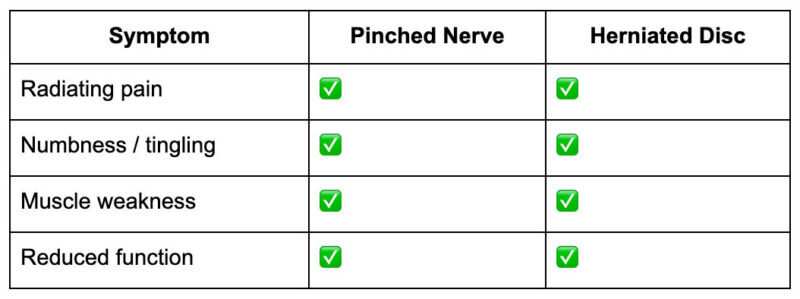
The overlap is significant – which is why professional evaluation matters far more than symptom-matching alone.
How to Tell if It’s Coming From the Neck or Lower Back
Signs of a Cervical (Neck) Issue
- Pain radiating into the shoulder, arm, or hand
- Numbness or tingling in specific fingers
- Neck stiffness with upper extremity symptoms
Signs of a Lumbar (Lower Back) Issue
- Pain radiating into the hip, thigh, calf, or foot
- Classic sciatica pattern – one-sided leg pain
- Lower back aching with leg weakness or altered sensation
Why Symptom Location Matters
Where you feel the symptom often maps to the spinal level where the nerve is being affected. A skilled clinician uses this information – along with physical examination – to narrow down the source before any imaging is ordered.
Can a Herniated Disc Cause a Pinched Nerve?
Yes – and it’s one of the most common relationships we see in clinical practice. When a disc herniates, the displaced material or surrounding inflammation can directly compress a nerve root exiting the spine at that level.
That said, not every pinched nerve comes from a herniated disc. Bone spurs, joint degeneration, tight muscles, and poor posture can all compress nerves without any disc involvement. This is another reason why accurate diagnosis – not guesswork – shapes the treatment plan.
What Causes These Conditions to Develop?
Common Contributing Factors
Most cases share a common thread of cumulative stress:
- Poor posture – especially prolonged forward head position or desk-based work
- Repetitive movements or occupational strain
- Heavy lifting with poor mechanics
- Age-related disc and joint degeneration
- Sedentary lifestyle that reduces spinal support
Why Spinal Alignment and Mechanics Matter
Structural stress on the spine compounds over time. Misalignment increases uneven pressure on discs and narrows the spaces through which nerves exit the spine. This is why the same movement that previously caused no issue can eventually trigger a significant episode.
How Are Pinched Nerves and Herniated Discs Diagnosed?
Clinical Evaluation
A thorough exam involves:
- Full symptom history – onset, behavior, aggravating and relieving factors
- Movement and orthopedic testing – which positions reproduce or relieve symptoms
- Neurological assessment – reflexes, sensation, and motor strength testing
Imaging When Necessary
- X-rays reveal structural alignment, disc height, and bone changes
- MRI provides the clearest picture of disc condition and nerve involvement
Why Self-Diagnosis Is Often Inaccurate
Given the overlap in symptoms between these two conditions – and the range of other causes that can produce the same sensations – self-diagnosis is unreliable. A 30-year practitioner will tell you: the same symptom presentation can have very different underlying drivers in different patients.
When Symptoms May Be a Red Flag
Some presentations require urgent medical evaluation – not a scheduled appointment:
- Progressive or rapidly worsening weakness in the arms or legs
- Increasing numbness spreading beyond its original area
- Loss of coordination or balance
- Changes in bladder or bowel function
- Severe or constant pain that isn’t relieved by any position
These symptoms can indicate significant nerve compression that needs immediate assessment.
Treatment Options for Pinched Nerve vs Herniated Disc
Conservative Care for Both Conditions
Most cases respond well to a structured conservative approach:
- Activity modification – reducing movements that load the affected nerve
- Targeted rehabilitation – restoring proper movement patterns and supporting structures
- Reducing inflammation – allowing nerve irritation to settle
When Treatment Approaches May Differ
Nerve irritation without structural disc involvement may respond faster than cases with significant disc herniation. Severity, duration, and how much nerve function is affected all shape the plan.
When More Advanced Care May Be Considered
When symptoms are severe, persistent, or significantly limiting function, additional options – including imaging-guided procedures or surgical consultation – enter the conversation. Most patients don’t reach that point with timely, appropriate conservative care.
When to Get Checked for Ongoing Pain or Nerve Symptoms
Don’t wait if:
- Symptoms have persisted for more than 2–3 weeks without improvement
- Pain, numbness, or tingling is recurring on the same pattern
- Symptoms are affecting daily activities – sleep, work, walking
- Symptoms followed a lifting incident, fall, or accident
Final Takeaway
These conditions are related but distinct. A herniated disc can cause a pinched nerve – but not every pinched nerve involves a herniated disc. Symptoms alone rarely tell the full story, and treating the wrong target delays real recovery.
At North Alabama Spine & Rehab, Dr. Adam Shafran brings 30 years of clinical experience to exactly these kinds of presentations. As your trusted Chiropractor Huntsville, AL, we use a thorough evaluation – history, examination, and imaging when indicated – to identify the true source of your pain and build a personalized treatment plan around it.
Schedule your evaluation today and finally get a clear answer about what’s actually causing your symptoms.