
Pros and Cons of Spinal Decompression Therapy: Is It Right for You?

Understanding the pros and cons of spinal decompression is essential before committing to treatment. This isn’t a one-size-fits-all solution, and like any medical intervention, it has both advantages and limitations. We’re going to walk through both sides honestly, so you can make an informed decision about your spinal health.
Let’s dive into what spinal decompression really offers and where it falls short.
The Pros of Spinal Decompression Therapy
Natural Pain Relief and Healing
The beauty of non-surgical spinal decompression therapy lies in its approach: working with your body’s natural healing mechanisms rather than cutting, injecting, or medicating your way past the problem.
Here’s how it works: motorized traction gently stretches your spine, creating negative pressure within the discs. This pressure change allows herniated or bulging disc material to retract, taking pressure off nerves. Simultaneously, the increased space promotes better blood flow and nutrient exchange, helping damaged tissues repair themselves.
Key advantages include:
- Zero incisions – Your skin stays intact, eliminating infection risks and scarring
- Drug-free relief – No pharmaceutical side effects or dependency concerns
- Promotes natural healing – Your body does the work; the therapy just creates optimal conditions
Research by Apfel et al. published in Neurosurgical Focus found that decompression therapy reduced disc herniation symptoms in 71% of patients without any invasive procedures. That’s significant for people trying to avoid surgery.
Improved Function and Mobility
Pain is only part of the equation. What really matters is getting back to living your life fully. Spinal decompression benefits and risks should always be evaluated through the lens of functional improvement, not just pain scores. Functional gains include:
- Increased spinal flexibility and range of motion
- Better posture as pressure on discs decreases
- Faster return to daily activities like gardening, playing with kids, or exercising
- Reduced need for pain medications
The treatment essentially gives your spine the space it needs to function properly. When discs aren’t compressed and nerves aren’t pinched, your body moves the way it’s designed to move.
Safe, Comfortable and FDA-Cleared
Safety concerns naturally arise when considering any treatment. The good news? Spinal decompression has an excellent safety profile compared to surgical alternatives.
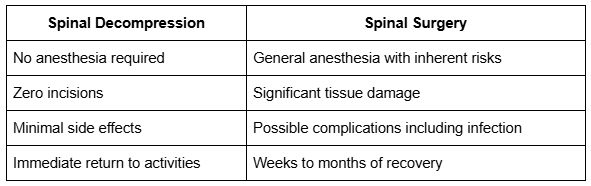
FDA-cleared devices and protocols mean the treatment meets rigorous safety standards. Sessions are performed by trained professionals who monitor your response continuously, adjusting pressure and positioning as needed.
Most patients describe the sensation as a gentle pulling or stretching – some even find it relaxing enough to doze off during treatment.
The Cons and Limitations of Spinal Decompression
Temporary Soreness or Mild Discomfort
Let’s set realistic expectations right from the start. While the treatment itself isn’t painful, you might experience some aftereffects initially.
Common temporary issues:
- Muscle soreness similar to post-workout achiness
- Mild stiffness for a day or two after early sessions
- Occasional increase in pain before improvement begins (healing response)
These spinal decompression side effects typically diminish as your body adapts to treatment. Think of it like starting a new exercise routine – your muscles need time to adjust to the changes.
Not Suitable for Everyone
This is crucial: spinal decompression isn’t appropriate for every back pain sufferer. Certain conditions make the treatment unsafe or ineffective.
Contraindications include:
- Spinal fractures – Traction could worsen the injury
- Pregnancy – Safety for the developing baby hasn’t been established
- Severe osteoporosis – Fragile bones may not tolerate the forces
- Metal spinal implants – Fusion hardware restricts the movement needed
- Advanced spinal stenosis – May require more aggressive intervention
- Tumors or infections – Underlying pathology must be addressed first
This is precisely why thorough evaluation comes before treatment. We use diagnostic imaging, physical examination, and detailed medical history to determine candidacy. Skipping this step could lead to wasted time and money or worse, injury.
Is spinal decompression safe for you specifically? Only a qualified provider can answer that after proper assessment.
Requires Commitment
Unlike popping a pill or getting a cortisone shot, spinal decompression demands time and consistency. This isn’t a quick fix. Treatment timeline reality:
- Typical protocol: 15-20 sessions over 4-6 weeks
- Each session: 20-30 minutes on the decompression table
- Requires multiple visits per week initially
- May not provide relief for severe cases needing surgery
Some patients get frustrated with the time commitment, especially when juggling work and family obligations. We get it – life is busy. But tissues heal on their own schedule, not ours.
Additionally, decompression works best for specific conditions like herniated discs, degenerative disc disease, and sciatica. If you have pain from arthritis, muscle strains, or other non-disc issues, you might need different treatments entirely.
See more: Improving Quality of Life with Decompression Therapy
Risks and Safety Considerations
Overall Safety Profile
The risk profile for chiropractic spinal decompression is substantially lower than surgical intervention, but it’s not zero. Understanding this helps set appropriate expectations.
Monitoring and safety protocols:
- Continuous patient feedback during sessions
- Gradual increase in traction force over multiple visits
- Ability to stop treatment immediately if discomfort occurs
- Regular reassessment of response and progress
Possible Side Effects
Beyond the temporary soreness mentioned earlier, other mild effects can occur:
- Temporary muscle spasms as tissues adjust
- Minor bruising at contact points (rare)
- Headaches in some patients (typically with cervical decompression)
- Fatigue as the body allocates resources to healing
These generally resolve quickly. If they persist or worsen, treatment protocols can be adjusted or discontinued.
When to Stop or Adjust Treatment
Communication between patient and provider is essential. You should alert us immediately if you experience:
- Increasing pain that doesn’t resolve between sessions
- New numbness, tingling, or weakness
- Loss of bowel or bladder control (seek emergency care)
- Severe muscle spasms that don’t ease
We’re constantly monitoring your response. If progress stalls after 6-8 sessions, we reassess whether decompression remains the best approach or if we need to pivot to other interventions.
Is Spinal Decompression Therapy Right for You?
This is the million-dollar question. Let’s break it down with practical criteria.
Ideal Candidates
You might be an excellent candidate if you:
Conditions that respond well:
- Herniated or bulging discs confirmed by MRI
- Degenerative disc disease causing chronic pain
- Sciatica with radiating leg pain from nerve compression
- Failed to find relief from conservative treatments like PT or medications
- Want to avoid surgery or are not yet a surgical candidate
- Have realistic expectations about time commitment
Signs It’s Time to Consider Decompression
When should you seriously look into this option? Watch for these indicators:
- Persistent pain – You’ve had back or neck pain for more than 6 weeks despite conservative treatment
- Nerve symptoms – Radiating pain, numbness, or tingling down arms or legs
- Functional limitations – Pain interferes with work, sleep, or daily activities
- Imaging confirmation – MRI or CT shows disc problems like herniation or bulging
- Surgery aversion – You’re trying to avoid or delay surgical intervention
When Other Treatments May Be Better
Conversely, you might need a different approach if:
- Your pain stems from muscle strains, arthritis, or spinal instability rather than disc issues
- You need immediate relief (decompression takes weeks to show full results)
- You have severe or progressive neurological deficits requiring urgent surgical attention
- Your lifestyle doesn’t allow the required treatment frequency
As a chiropractor in Huntsville AL, we always match the treatment to the patient, not force patients into a predetermined protocol.
Ready to Find Out If Decompression Is Right for You?
Spinal decompression offers genuine hope for people suffering from disc-related back pain who want to avoid surgery. It’s not a miracle cure, but for the right candidate, it can be life-changing. Success depends on proper patient selection, consistent treatment attendance, and realistic expectations.
Understanding spinal decompression benefits and risks allows you to approach treatment as an informed participant in your own care – not a passive recipient hoping for magic.
At North Alabama Spine & Rehab, we provide comprehensive evaluations to determine if you’re a good candidate for back pain treatment alternatives like decompression therapy.
Schedule your consultation today to explore whether spinal decompression can help you live pain-free. Let’s create a personalized plan that addresses your specific needs and gets you back to the activities you love.
Don’t let uncertainty keep you in pain. Call us now and take the first step toward lasting relief.