
What Are Soft Tissue Injuries After a Car Crash? Causes, Symptoms & Best Treatment Options

Soft tissue injuries are damage to muscles, ligaments, tendons, fascia and connective tissues – the structures that support and move your body. After a car crash, these injuries are incredibly common yet often overlooked because they don’t show up on X-rays. This guide explains what soft tissue injuries are, why they’re often missed, and the most effective treatments for complete recovery.
Understanding Soft Tissue Injuries
What Are Soft Tissue Injuries?
Soft tissue injuries affect the body’s support structures – everything except bones and joints:
- Muscles (move your body)
- Ligaments (connect bone to bone)
- Tendons (connect muscle to bone)
- Fascia (connective tissue wrapping everything)
- Intervertebral discs (cushion between vertebrae)
Why they’re vulnerable in crashes: Soft tissues absorb sudden forces poorly. Even low-speed collisions create hyperextension, compression, and tearing that bones might survive intact.
Why Soft Tissue Injuries Are Often Overlooked
ER X-rays only show bones. Unless you have fractures or dislocations, you’re often cleared and sent home – despite significant soft tissue damage.
Symptoms delay 12-72 hours: Inflammation takes time to build. Adrenaline masks initial pain. You feel “okay” at the accident scene but wake up the next morning unable to move your neck.
Invisible injuries create long-term consequences. Without proper treatment, acute soft tissue damage becomes chronic pain, stiffness, and permanent structural problems.
Acute vs. Chronic Soft Tissue Injuries
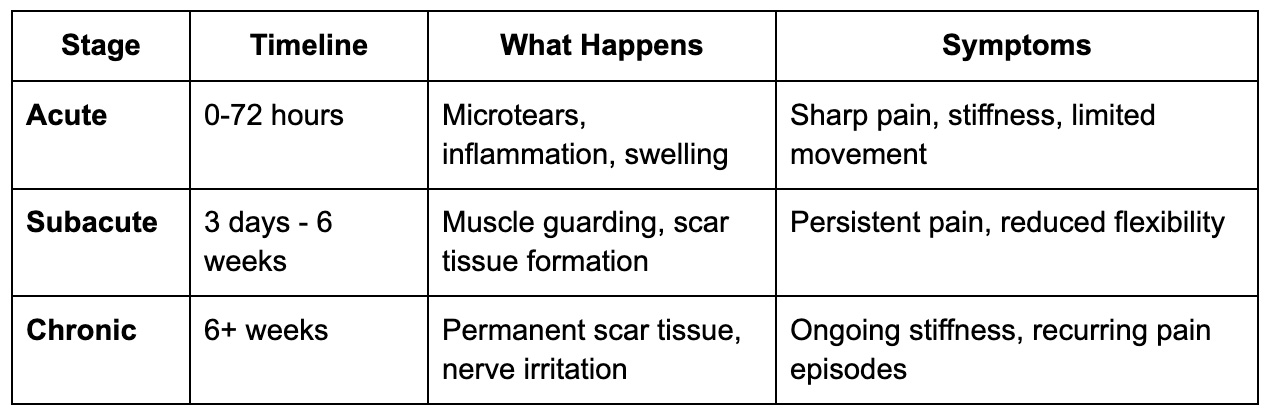
Untreated injuries become chronic pain syndromes. Scar tissue replaces healthy tissue, joints stiffen, posture deteriorates, and pain becomes your new normal.
Common Types of Soft Tissue Injuries After a Car Crash
Sprains (Ligament Damage)
Ligaments stretch or tear when joints move beyond normal range. Neck and lower back ligaments commonly sprain in rear-end collisions.
Symptoms: Joint instability, pain with movement, swelling around affected area.
Strains (Muscle/Tendon Damage)
Muscles or tendons overstretch or tear from sudden forces. Neck, shoulder, and back muscles are most frequently affected.
Symptoms: Muscle spasms, weakness, pain when using the muscle.
Contusions & Deep Bruising
Direct impact (seatbelt, airbag, dashboard) causes bleeding within muscle tissue.
Symptoms: Visible bruising, tenderness, localized swelling.
Whiplash & Cervical Acceleration-Deceleration Injury
The most common soft tissue injury after a car accident. Your head whips forward then backward, stretching neck structures beyond limits.
Affects: Cervical ligaments, muscles, discs, facet joints, nerve roots.
Symptoms: Neck pain, headaches, dizziness, jaw pain, arm numbness.
Tendonitis & Overstretch Injuries
Tendons connecting muscles to bones become inflamed from sudden stretching forces.
Common sites: Rotator cuff (shoulder), Achilles tendon (if bracing during impact).
Myofascial Pain & Trigger Points
Fascia (connective tissue webbing) develops tight bands and trigger points causing referred pain patterns.
Symptoms: Pain radiating away from injury site, muscle knots, chronic stiffness.
Disc-Related Soft Tissue Injuries
Intervertebral discs tear or bulge from compression forces:
- Herniated disc: Inner gel pushes through outer wall
- Bulging disc: Disc expands beyond normal boundaries
- Annular tears: Cracks in disc’s outer layer
Symptoms: Radiating arm/leg pain, numbness, weakness.
Fascia Damage (Highly Overlooked)
Fascia injuries create chronic stiffness that persists long after acute pain resolves. This connective tissue damage directly affects posture and movement patterns, leading to long-term biomechanical problems.
How Car Accidents Cause Soft Tissue Injuries
Biomechanics of a Collision
- Hyperflexion/hyperextension: Head and neck bend beyond normal limits (forward and backward).
- Shearing forces: Different body parts move at different speeds, creating tissue tearing.
- Rotational forces: Twisting motions damaging structures not designed for rotation.
- Compression forces: Sudden impact compressing spinal discs and vertebrae.
Types of Accidents That Commonly Cause Soft Tissue Damage
- Rear-end collisions: Account for 85% of whiplash injuries. Even at 5-10 mph, forces generate enough trauma to injure cervical soft tissues.
- Side-impact crashes: Create lateral flexion and rotation injuries affecting neck, shoulders, and thoracic spine.
- Head-on collisions: Severe compression and extension injuries throughout the spine.
- Low-impact crashes with “no vehicle damage”: Don’t be fooled – your body absorbs forces even when your car doesn’t show damage.
Why Symptoms Can Be Delayed
- Inflammation timeline: Swelling and inflammatory chemicals build over 24-72 hours, gradually increasing pain.
- Protective muscle guarding: Your body tenses muscles to protect injured areas, creating secondary muscle strain.
- Neurological vs. muscular symptoms: Nerve irritation from swelling may not appear until inflammation peaks days later.
Best Treatment Options for Soft Tissue Injuries
Early-Stage Care (First 48-72 Hours)
- Controlled rest: Avoid complete immobilization (old-school neck collars worsen outcomes). Gentle movement prevents stiffness.
- Ice therapy: First 48 hours to reduce inflammation. 15-20 minutes every 2-3 hours.
- Avoid aggravating activities: No heavy lifting, sudden movements, or positions that increase pain.
Chiropractic Adjustments
Chiropractic for soft tissue injuries addresses the root mechanical problems:
- Restores joint mobility: Gentle adjustments improve cervical and spinal movement
- Reduces nerve irritation: Decompresses pinched nerves from misalignment
- Realigns spinal structure: Corrects vertebral positioning disrupted by crash forces
Research by Woodward et al. in Journal of Manipulative and Physiological Therapeutics found that chiropractic treatment for whiplash reduced pain and disability scores by 43% within 4 weeks.
Chiropractic BioPhysics® (CBP) Correction
As a chiropractor Huntsville patients trust for advanced care, I use CBP to address long-term structural problems:
- Corrects abnormal posture from protective muscle guarding
- Improves spinal biomechanics preventing chronic complications
- Prevents permanent scar tissue formation through proper alignment
- Uses mirror-image® adjustments and traction for structural remodeling
Spinal Decompression Therapy
Non-surgical decompression helps disc-related injuries:
- Relieves pressure on damaged discs and pinched nerves
- Creates negative pressure drawing nutrients into injured tissues
- Promotes tissue rehydration and healing
- Effective for disc bulges, herniations, and chronic whiplash
Soft Tissue & Rehabilitation Modalities
- Myofascial release: Breaks up fascial restrictions and trigger points
- Therapeutic stretching: Restores normal muscle length and flexibility
- Physical therapy strengthening: Rebuilds muscle support around injured areas
- SoftWave/shockwave therapy: Accelerates healing through acoustic wave technology
- Massage therapy: Reduces muscle tension and improves circulation
- Anti-inflammatory nutrition: Omega-3s, turmeric, antioxidants supporting healing
When to See a Chiropractor or Spine Specialist
Seek professional care if:
- Pain persists beyond 48-72 hours
- Symptoms worsen instead of improve
- Over-the-counter treatments don’t help
- You want to prevent chronic complications
- Movement becomes increasingly restricted
How Chiropractic + CBP + Decompression Create Full Recovery
Combining these approaches addresses every aspect of soft tissue injury after car accident:
- Immediate pain relief through adjustments
- Structural correction preventing chronic problems
- Disc healing via decompression therapy
- Soft tissue rehabilitation restoring normal function
What to Expect During Your First Visit
- Comprehensive evaluation: Health history, accident details, symptom timeline
- Physical examination: Range of motion testing, orthopedic assessments, neurological screening
- Diagnostic imaging: X-rays revealing structural damage and misalignment
- Treatment plan: Customized protocol addressing your specific injuries
Don’t Let Soft Tissue Injuries Become Chronic Pain
What are soft tissue injuries? They’re the hidden damages after car accidents that X-rays miss but that can change your life if left untreated.
At North Alabama Spine & Rehab, we’ve spent 30 years helping accident victims recover completely using advanced chiropractic techniques, CBP structural correction, and spinal decompression therapy.
Don’t wait for soft tissue injuries to become chronic problems. Schedule your comprehensive evaluation today. We’ll identify all hidden injuries, explain exactly what’s damaged, and create a treatment plan for complete recovery – not just temporary symptom relief.
FAQs
Can soft tissue injuries be permanent?
Without proper treatment, yes. Scar tissue replaces healthy tissue, creating permanent stiffness and chronic pain. Early intervention prevents this.
Can soft tissue damage appear days later?
Absolutely. Inflammation builds over 12-72 hours. Many patients feel “fine” initially, then wake up unable to move their neck the next morning.
Can chiropractic help soft tissue injuries?
Yes. Studies show chiropractic care reduces recovery time, improves function, and prevents chronic complications better than medication or rest alone.
What’s the difference between whiplash and a strain?
Whiplash is a specific mechanism (acceleration-deceleration) causing multiple soft tissue injuries. A strain is one type of soft tissue injury affecting muscles or tendons.